The State of Working Wisconsin 2023
Workers’ perspective on the Wisconsin economy.
In celebration of Wisconsin workers, High Road Strategy Center releases The State of Working Wisconsin 2023 with the most recent data available on wages, jobs, and unions in order to build a stronger understanding of the workers’ experience of the state’s economy.
This year, Wisconsin’s workers continue to enjoy strong job growth and low unemployment, but most workers’ wages didn’t grow fast enough to stay ahead of high inflation in 2022. Importantly, in terms of wages, workers at the bottom of the labor market did better than those at the top, reducing wage inequality in the state.
Key Working Wisconsin Facts
The number of jobs in the state reached a record high of 3,007,200 in July 2023. Wisconsin’s unemployment rate reached a record low of 2.4% in April and May, and has been below 3% for nearly the entire past 12 months.
Women in Wisconsin have consistently worked at higher rates than women in the nation, but the gap in participation is shrinking since 2019. In 2022, Wisconsin’s women’s labor force participation dipped below 60% for the first time since the late 1980s.
Nominal wages grew in 2022, but the wage growth was not fast enough to keep pace with high inflation. The median in 2022 was down to $22.02 and the decline brought a decade of wage growth to an end.
Workers at the bottom are taking advantage of the tight labor market to lift wages. Wages for Black and brown workers in the state are growing and have outpaced inflation over 2019-2022. (Over that same period, white workers have seen little real change.) Wage inequality has declined as a result.
In spite of increasing organizing and high public support for unions, Wisconsin’s rate of unionization continues to fall. The decline from 2011 to 2022 is the most extreme in the region.

Jobs
Wisconsin’s Labor Market is setting records in 2023. Unemployment has reached historic lows, and the number of jobs has increased to historic highs.
Wages
Inflation rose more rapidly than wages leaving the median worker slightly behind. For lower wage workers, wage gains are stronger and the state’s racial wage gaps have slightly closed.

Unions
Wisconsin unionization has seen a steady downward slide over the last 50 years and a steep decline as a direct result of Act 10. Over the past decade, Wisconsin’s union decline is the worst of all states in the region.
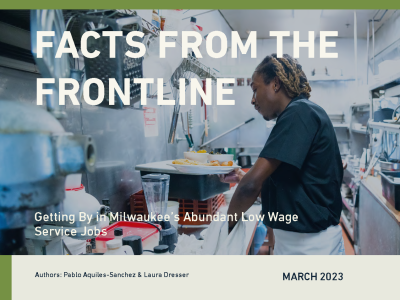
Facts from the Frontline
Union manufacturing jobs that once flourished in Milwaukee have been replaced by low-wage, non-union service jobs, exacerbating racial and economic disparities. This report documents the structure of these jobs and the workers who hold them. The report also offers insights from service workers themselves about the work and how they are trying to improve it.
What are Bad Jobs?
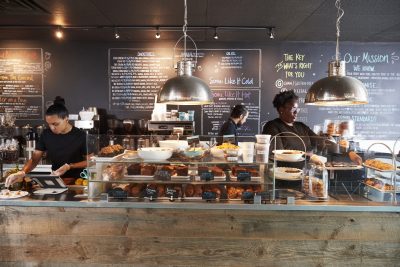
Bad jobs pay less than $15 an hour. 100,608 of Milwaukee’s 243,221 workers (41%) work in bad jobs.
Who is in Bad Jobs?
– 31% of white workers – 51% of Black workers – 56% of Hispanic workers
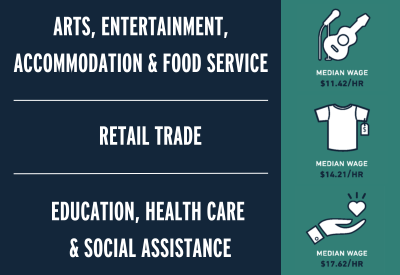
Three industries
account for more than 60,000 of Milwaukee’s Bad Jobs.

“In service work, you are constantly shown how replaceable you are. At a drop of a dime, they claim we can have you gone.”

“Everything is going up: food, gas – but salaries are not. The CEOs just don’t want to put the money forward.”
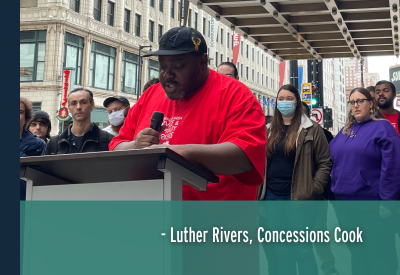
“[The union] made a whole world of difference, gave me the comfort knowing that co-workers wouldn’t be fired on a whim.”
Acknowledgments
The State of Working Wisconsin 2023 is written by Laura Dresser, Joel Rogers and Pablo Aquiles-Sanchez.
This report would not have been possible without the support of a dedicated team of High Road Strategy Center staff including Leslie Vasquez and Quincy Midthun. We would also like to thank the Economic Policy Institute (EPI) in Washington DC for their support with data and analysis.